
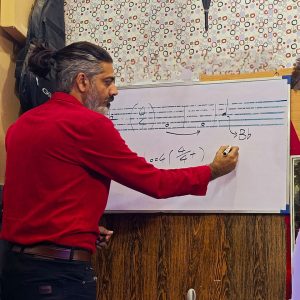
Hossein Sabbaghi is an independent composer, producer, and music educator whose work blends technical precision with emotional depth. Entirely self-taught, he has spent years mastering mixing, EQ, and psychoacoustic design—often under severe technical limitations.
His album Glucose, produced between 2009 and 2010 using basic equipment, stands as a testament to artistic resilience and creative engineering. But Sabbaghi’s impact goes far beyond music production. In his classes, he avoids performing or dictating repertoire; instead, he teaches theoretical and technical concepts with scientific clarity. The image captures a moment from a structured and professional music lesson, where concepts are presented with clarity and precision.
Sabbaghi’s teaching is rooted in European music theory, using precise terminology, structural analysis, and conceptual depth. He distances himself from superficial methods that rely on gestures or vague explanations, empowering students to understand music with clarity and confidence. When beginners ask, “How many songs will we learn in the first term?” he smiles and replies, “Any melody you like—you’ll be able to play it by the fourth session of the first term!” That answer marks the beginning of a surprising and transformative journey.
In Iran’s music education landscape, unfortunately, some methods lack scientific foundation and rely on exaggerated promises. Even in well-known institutions, underqualified instructors and a lack of theoretical depth are common—where vague gestures replace structured analysis. In this environment, Sabbaghi’s analytical and disciplined approach stands apart, sometimes provoking hostility from opportunistic figures who feel threatened by his transparency and expertise. Yet he remains committed to his ethical and academic standards, showing students that music demands understanding, honesty, and structure.
Sabbaghi’s personal studio, once a modest teaching space, has evolved into an academy-like environment—driven by growing demand. Today, it hosts not only students from Mashhad and across Iran, but also international music students: visitors from India, Afghanistan, and Arab countries, as well as Persian-speaking vocalists based in Europe who occasionally seek his guidance without prior appointments. This widespread interest reflects the trust in his method and the expanding global reach of his educational philosophy.
In his teaching, Sabbaghi often helps students refine their original melodies with technical insight. He even tells some of them not to credit him in the official documentation of their work—calling it an “educational gift,” not a claim of ownership. This humble and professional attitude has helped many of his students find their artistic path and begin producing music independently.
The instruments Sabbaghi knows in depth—not just as a performer, but as a technical and structural specialist—include classical nylon-string guitar, digital piano, various synthesizers, and percussion instruments such as daf, darbuka, tombak, and electronic drums. This broad expertise allows him to offer multi-dimensional insights in both teaching and musical analysis.
Comments